
Energy Transition: synergies and impacts on water management
- Completed, STREAM
This project aimed to establish an inventory of water resources and their uses (drinking water, irrigation, hydroelectricity, thermal uses, tourism) across two catchments in Valais, in order to identify rivalries and synergies between uses in the context of the energy transition and climate change. For the Sionne catchment, 2021 was chosen as it allowed comparison between municipalities. For Val de Bagnes, the choice fell on 2023. However, 2022, a drier year, is sometimes studied to provide a more contrasting picture.
Duration: 05.2024–04.2025
Results
Sionne catchment (Sion, Arbaz, Grimisuat, Savièse)
The outflow volume on the Sionne (2021) is 16 million m³, but the flows measured at the outlet do not reflect the natural regime. To calculate the volumes of water withdrawn from the Sionne (see Figure 2), we subtracted external inputs of 3 million m³ (transfers via bisses from neighbouring catchments) from withdrawals of 8 million m³ (spring catchments, water intakes). Summer demand (≈600,000 m³/month) is nearly double winter demand, due to irrigation.
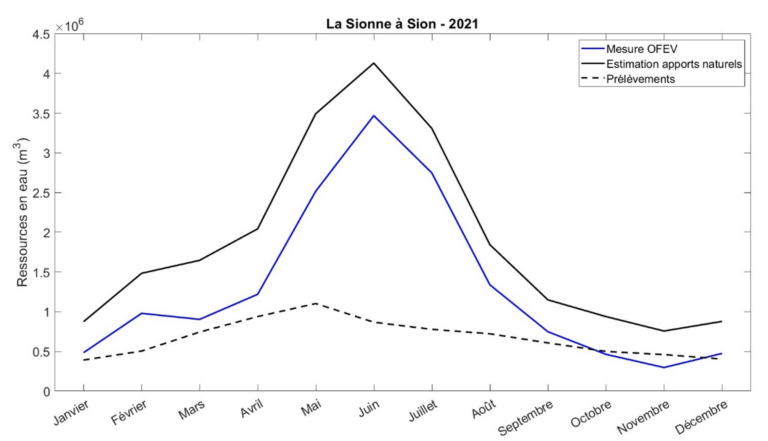
Figure 2: Estimate of natural inputs, water volumes measured by the FOEN at the catchment outlet, and withdrawals within the catchment for 2021.
The use of the Hydro-CH 2018 scenarios made it possible to estimate the future evolution of flows at the outlet (see Figure 3): note that these scenarios use models calibrated on flows already modified by human activity.
Drinking water is also harnessed by 6 cascading turbines: the Arbaz springs are turbined across two stages (Comba Energies, Sionne Energies), supplemented by 4 OIKEN turbines. Total annual production ranges from 6 to 7 GWh (2021–2023), equivalent to the estimated electricity consumption of the residents of Arbaz and Grimisuat.
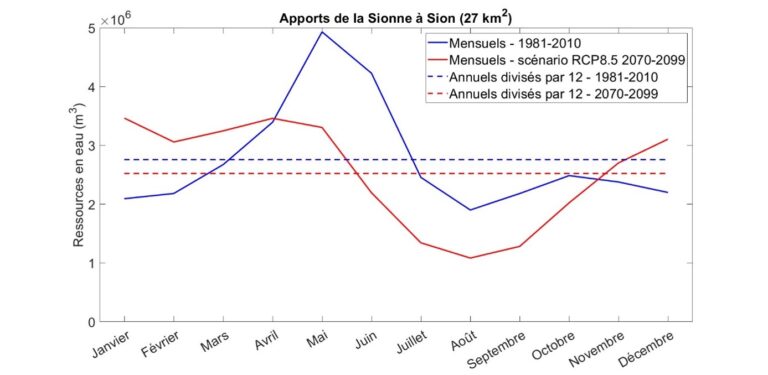
Figure 3: Estimate of natural inputs of the Sionne at Sion for the reference period (1981-2010) and at the end of the century (2070-2099) under the high greenhouse gas emission scenario (RCP 8.5), based on HydroCH-2018 data.
Val de Bagnes (right bank up to Louvie)
Surface water resources were assessed via Lac de Louvie (total volume of 450,000 m³), the 77 captured springs, and the 12 intakes used for irrigation on the lateral streams of the Dranse using Hydro-CH2018 data. The natural resource in the streams is significantly greater than the inflows to the lake throughout the year, with a peak in June (see Figure 3); however, the lake makes it possible to have drinking water available in winter and water for irrigation in summer in the case of a very dry year.
6 turbines (out of the nine located in the municipality) are situated within the study area, turbining both drinking water (4 turbines, Verbier sector) and raw water intended for irrigation (Pas du Lein and Cries). Annual production for the municipality as a whole (excluding turbining on wastewater) ranges from 10 to 17 GWh (2022–2024), the increase being linked to the commissioning of the Montoz plant (2024). In 2023, production (13 GWh) was close to the estimated electricity consumption of the 10,534 residents. Lac de Louvie plays a storage role that allows production to be spread out over time, unlike the Sionne, where production directly follows snowmelt.
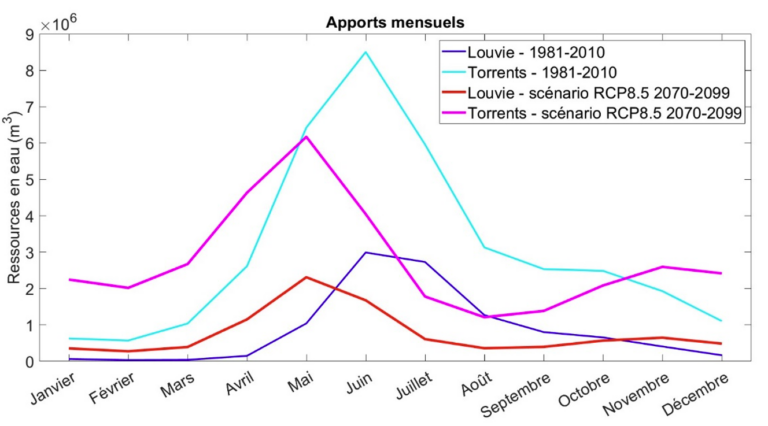
Figure 4: Estimate of inputs to Lac de Louvie and of volumes available at the water intakes on the lateral streams (including inputs to Lac de Louvie) for the reference period (1981-2010) and at the end of the century (2070-2099) under the high greenhouse gas emission scenario (RCP 8.5), based on Hydro-CH2018 data.
Cross-cutting findings
In both catchments, resource peaks (spring–early summer) do not coincide with usage peaks (July–August). Future scenarios (RCP 8.5, 2070–2099) predict a reduction in flows from April to October and a winter increase, which will accentuate the mismatch between resource and usage peaks. Hydroelectric production is expected to see its peak shift towards April, with increasing inter-annual variability.
The study highlights a strong need for monitoring data and the need to model network management in order to test resource allocation scenarios. This work also included other contributions on the different water uses and the mapping of the different perimeters, available in the documents cited below.
Who took part?
- HES-SO Valais-Wallis (F. Mettra, E. Neveu, G. Houillon, T.Rey)
- CIRM/UNIL
- Altis, OIKEN
- Municipalities of Val de Bagnes, Arbaz, Grimisuat, Sion, Savièse
Funding: Service des hautes écoles, Canton du Valais & BlueArk
Outreach
Media:
- VdB Mag (June 25, https://www.valdebagnes.ch/_docn/5824147/VdBMag_10-WEB.pdf)
- RhôneFM (July, https://www.rhonefm.ch/valais/lhiver-verra-une-hausse-des-ressources-en-eau-tandis-que-lete-connaitra-une-forte-baisse-1049651),
- Aqua & Gas (Sept., https://www.aquaetgas.ch/fr/eau/eau-potable-et-eaux-souterraines/20250905-ag09-périmètres-pour-la-gestion-intégrée-de-l-eau/),
- BlueArk (Sept., https://blueark.ch/news/gestion-de-leau-en-valais-et-transition-energetique-un-equilibre-delicat-a-preserver/)
Scientific:
- BlueArkConference (Nov 2024)
Video: https://youtu.be/dj4esbusJNc?si=Yzwsoi1PtHctMh9C
Report available: https://serval.unil.ch/fr/notice/serval:BIB_6CD5ED2B9DEB