
Multi-use of water and integrated management at the regional scale
- Completed, STREAM
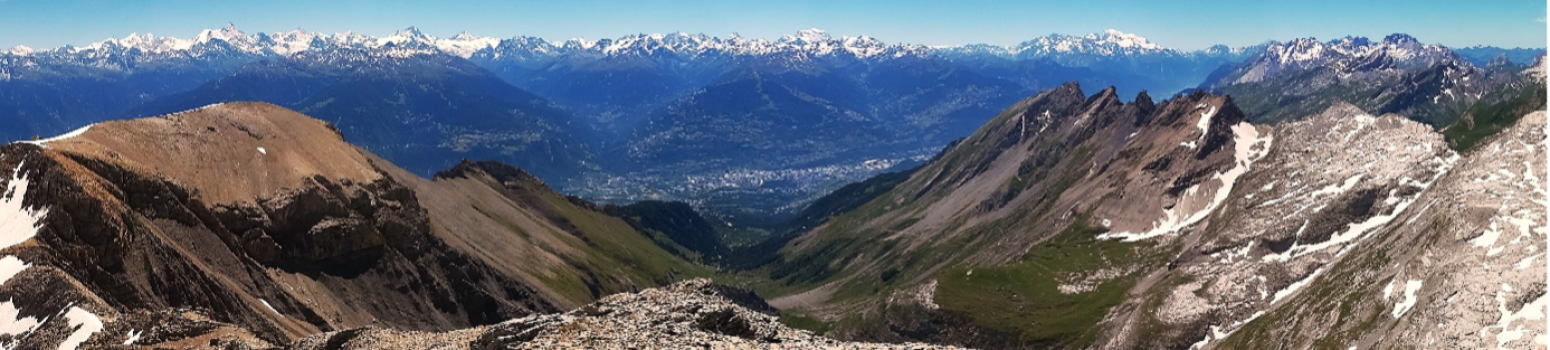
This project extends the study Transition énergétique et Multiusage de l’eau (2024–2025) by expanding it to five municipalities on the adret (sun-facing slope) of central Valais, across the catchments of the Morge, the Sionne and the Lienne (Arbaz, Grimisuat, Ayent, Savièse, Sion). In a region where small karstic basins, water transfers via bisses and pipelines, and municipal boundaries do not coincide, classic “by catchment” management reaches its limits. The objective is to quantify resources and uses (drinking water, irrigation, hydroelectric and thermal energy, tourism, heritage), to add a governance component, and to propose a regional management concept based on a functional area combining the catchment, use basins and municipal boundaries.
Duration: 05.2025–05.2026
Results
Evolution of resources
The future resource was assessed for each sub-catchment using the Hydro-CH2018 grid data (RCP 8.5, 2085 horizon). On the Sionne catchment, where a FOEN flow measurement exists and where anthropogenic uses could be estimated (see the Transition énergétique et Multiusage de l’eau project), this calculation was supplemented by a detailed hydrological model (using the RS MINERVE software) calibrated on the naturalised flows of 2021 (see Figure 1). In the absence of equivalent data elsewhere, the resource for the other sub-catchments relies on Hydro-CH2018 alone.
The projection results are consistent across sub-catchments, with a winter increase, a sharp summer decrease (on the order of −60% in July), and a low-flow period that shifts from winter to late summer. The headwater catchments are the most affected, in particular the upper Morge (up to −70% in July) due to the disappearance of the Tsanfleuron glacier, and the karstic springs of the Lienne fed by the Plaine Morte and Wildhorn glaciers. On the Sionne, where the 30-year averages of Hydro-CH2018 smooth out the signal (see Table 1), RS MINERVE shows that the low flows at the end of the century could potentially be more severe than those of 2003 and 2022, with a substantial spring snowmelt peak not being enough to avoid an extreme summer drought (see Figure 2).
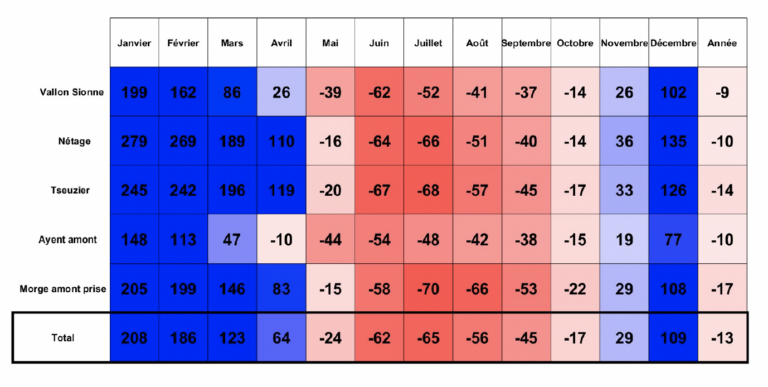
Table 1 : Monthly and annual changes (%) in water resources for the upstream catchments by 2085 under the RCP8.5 scenario, compared to the reference period (1981–2010), based on the Hydro-CH2018 dataset.
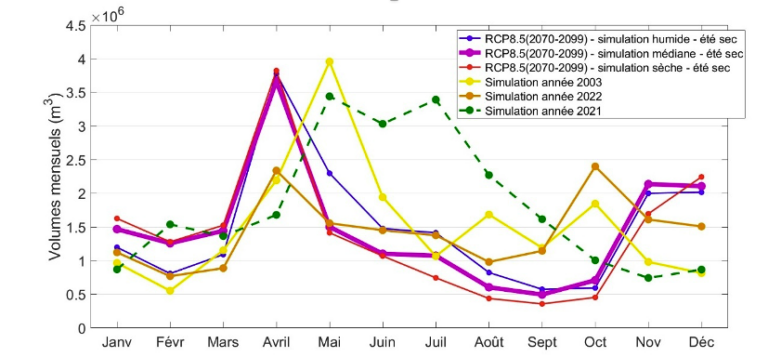
Figure 2 : Simulation of the Sionne’s water resource at Sion using the RS Minerve model, for the years 2003, 2022 and the year with the driest summer among 3 simulations at the 2085 horizon (30-year period) of the RCP8.5 scenario, drawn from the CH2018 Swiss climate scenarios (2 extreme simulations, dry and wet, and the median simulation). The year 2021 was also added for comparison.
Uses and balances
Flows were mapped by municipality and monthly balances established for the year 2021. Consumption doubles between winter (≈300,000 m³/month) and summer (500,000–650,000 m³/month), driven by irrigation. The inter-municipal comparison reveals major disparities, with network losses ranging from 12% (Sion) to more than 50% (Ayent, Savièse), also reflecting a lack of reliable measurements.
Governance and regional concept
The governance diagnosis describes a fragmented system involving five municipalities, one operator (OIKEN) and numerous consortages, perceived as functional but poorly formalised at the regional scale and lacking for irrigation. The study concludes that neither the catchment nor the infrastructure constitutes a relevant management territory here: only an inter-municipal division, integrating all uses, makes sense. It recommends a progressive integration (monitoring, planning, data governance) and assesses several governance structures, including a Commission locale de l’eau, based on the French model.
Who took part?
- HES-SO Valais-Wallis / STREAM (G. Houillon, F. Mettra, T. Rey, E. Neveu)
- CIRM / UNIL (E. Reynard, S. Rondi)
- Municipalities of Arbaz, Grimisuat, Ayent, Savièse, Sion; OIKE
Funding: Interinstitutional Project PInter (Service des hautes écoles / Canton of Valais)
Outreach
Media:
- SimHydro Nice (June 25), Proceedings Mettra et al. 2025 ( https://neveue.github.io/pdf/Paper-simhydro2025_v1_submitted_01052025.pdf)
- Swiss GeoSciences Meeting Bern (Dec. 25, https://geoscience-meeting.ch/sgm2025/wp-content/uploads/abstracts/Neveu_Emilie_08-28-25-06-28-22.pdf)
- Scientific conference, Water resources and droughts from 1960 to 2100 in Central Valais, Switzerland, SHF Symposium – Drought: From 1976 to today, what advances in the knowledge and management of droughts to better adapt to future crises? 15–18 June 2026, Champs-sur-Marne (France) https://neveue.github.io/pdf/Mettra_Neveu_article_Secheresse2026.pdf