

Stochastic Generation of Hourly Meteorological Time Series
- Completed, STREAM
Swiss climate projections (CH2018 and CH2025) and part of the historical observations are only available at the daily time step. This project develops a temporal downscaling method based on conditional GANs (generative adversarial networks) to generate realistic hourly meteorological data from daily data. Unlike other statistical or stochastic approaches, the properties of climate scenarios (seasonal and daily behaviour), while enabling better temporal resolution at the stations of interest. Furthermore, these generators learn temporal structures and inter-variable relationships, and are known to better represent extremes than other generators such as Variational Auto Encoders.
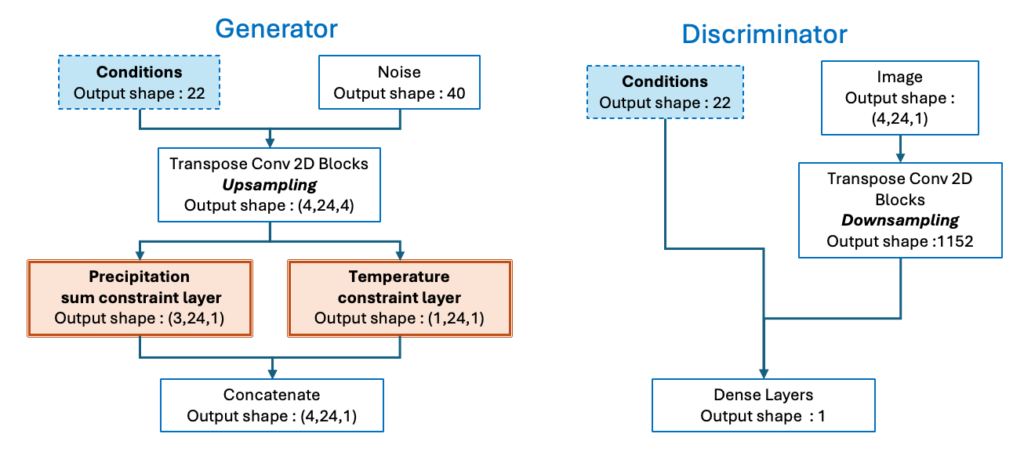
Figure 1: Architecture of Generative Adversarial Networks with conditions in blue and hard constraints in orange
Results
Method: GANs with Hard Physical Constraints
The originality of the approach lies in the integration of hard physical constraints directly into the generator architecture: a computation step enforces the sum of hourly precipitation to equal the measured daily sum, and temperatures are rescaled between the daily extrema. The methods can also be conditioned using 22 variables (weather context, seasonality). A study comparing the effect of conditioning and forcing demonstrates that the two mechanisms are complementary.
Validation on 11 Years of Data – Vallée de Joux
Trained on 9 years and tested on 2 years of hourly measurements from 4 Jura stations, the conditioned and forced GAN outperforms the random-baseline reference method in distributional fidelity (Wasserstein distance : 0.013 mm/h vs 0.049 mm/h), in inter-station correlations, and in reproducing precipitation extremes (see Figure 2).
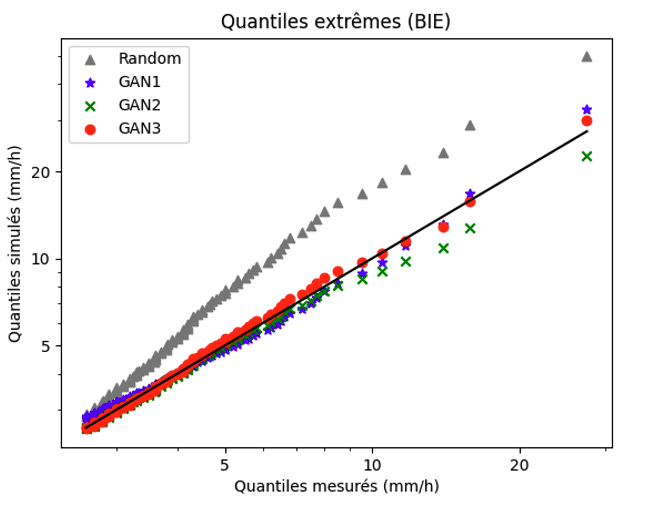
Figure 2 Extreme quantiles from 0.99 for the Bière BIE Station (01.10.2014-30.09.2025).
Application to Climate Scenarios and Return Periods
Applied to the CH2025 scenarios, GAN3 generates realistic hourly precipitation distributions, reproducing past statistics while adapting to the new context. For the +3°C scenario (GWL3.0), the hourly 10-year return period increases from 57 mm/h (reference state) to 74 mm/h, indicating a substantial intensification of future extreme events.
We are currently validating this methodology on another test case for publication.
Who is working on this project now?
STREAM (F. Terrettaz, E. Neveu, F. Mettra)
Funding : Innosuisse (STORE Project) & STREAM